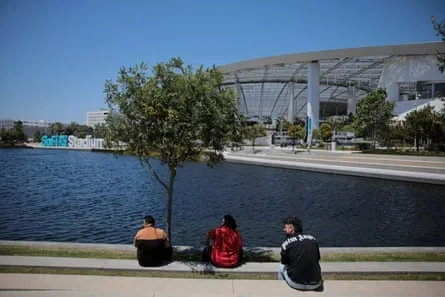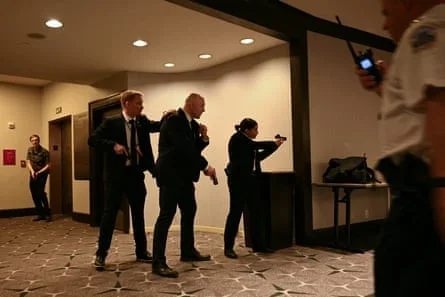
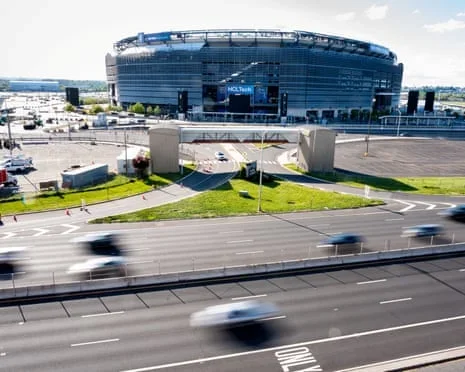
Only the final at MetLife Stadium will be designated as a “national special security event.” (Photo: Angelina Katsanis/Reuters)
World Cup matches across the United States are confronting elevated terrorism risks, with experts warning that vulnerabilities are intensified by the US-Israel conflict with Iran and a depletion of counter-terrorism expertise within federal law enforcement. The greatest threat comes from homegrown violent extremists, often lone actors radicalized online by extreme political views or jihadist groups like the Islamic State (Isis), according to four counter-terror experts interviewed.
“We need to protect not only each venue but all the other links in the chain leading to the game,” said Javed Ali, associate professor at the University of Michigan, who previously served at the FBI, Department of Homeland Security, and as National Security Council senior director for counter-terrorism. “There are so many games. There are only so many resources to deploy to try to buy down risk against a number of different threats.”
In March, the FBI held a large residential training exercise on domestic threats, gathering agents from across the country who specialize in domestic terrorism ahead of major national security events such as the World Cup. During the meeting, agents discussed the scale and complexity of securing the tournament and were “alarmed, because there’s a lot that needs to be dealt with,” said one federal law enforcement member who spoke on condition of anonymity. “It will be hard to control, given the environment and the number of locations of matches and watch parties across the United States. There is a very real possibility that something bad will happen.”
Although the US has experience securing large-scale stadium events like the NFL Super Bowl, experts say the sheer number of World Cup matches demands an unprecedented level of coordination, vigilance, and stamina. The tournament spans about six weeks, with 104 matches across the US, Canada, and Mexico. The US will host 78 matches in Atlanta, Boston, Dallas, Houston, Kansas City, Los Angeles, Miami, Philadelphia, the San Francisco Bay Area, Seattle, and East Rutherford, New Jersey—about 10 miles from Manhattan.
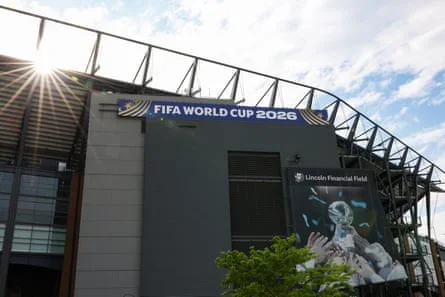
A view of Lincoln Financial Field in Philadelphia, Pennsylvania. The stadium will be known as Philadelphia Stadium for World Cup games. (Photo: Emilee Chinn/Getty Images)
The Department of Homeland Security has confirmed that only the final—held at MetLife Stadium in East Rutherford—will be designated a “national special security event” (NSSE). This designation triggers a centralized federal operation led by the US Secret Service, with FBI intelligence and emergency coordination from the Federal Emergency Management Agency (FEMA). It includes hardened security perimeters, magnetometer screening, temporary flight restrictions enforced by the Federal Aviation Administration, counter-drone systems, and continuous counter-terrorism monitoring across federal, state, and local agencies.
Other matches will receive a Special Event Assessment Rating (SEAR) 1 or 2, the two highest risk rankings, which also require federal law enforcement deployment. FEMA has allocated $625 million to support security and emergency preparedness for the World Cup. While all